
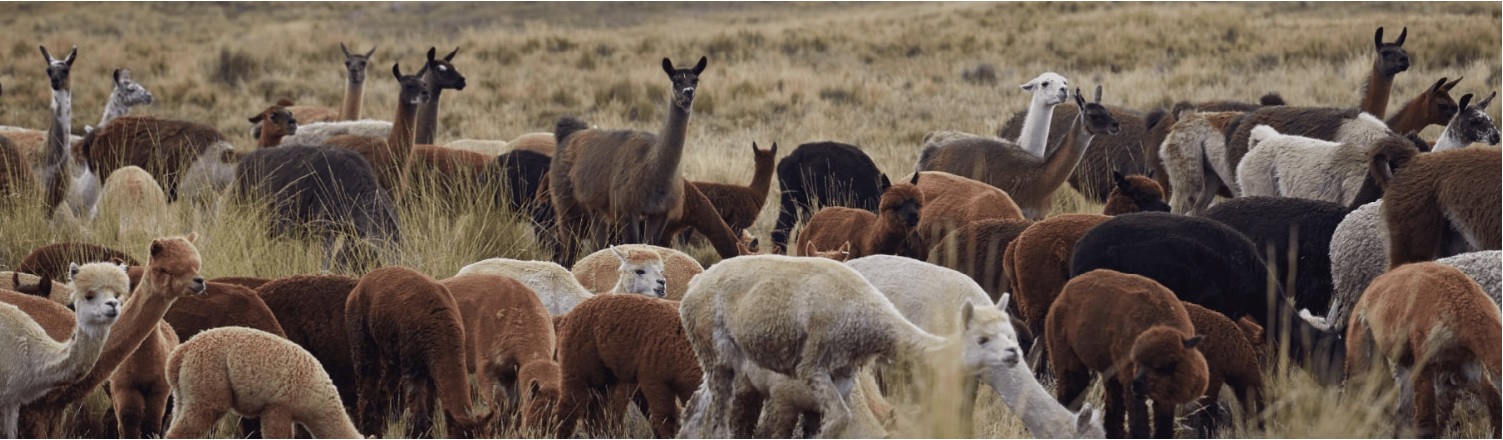
South American Camelids.
South American camelids primarily inhabit the Andes Mountains of Peru. Their breeding is a vital economic activity for a large segment of the Andean population. In Peru, camelid farming is very basic, a staple of the local economy, generally in high Andean areas very close to glaciers. In the city of Cusco, there are two locations: Ausangate and Salkantay, where vicuñas and guanacos are raised, in addition to alpacas and llamas.
Camelids are a fascinating group of four species, divided into two domesticated and two wild. While they may appear similar at first glance, they vary significantly in size, fiber quality, and temperament.
The four South American camelids at a glance.
| Feature | Llama | Alpaca | Vicuña | Guanaco |
| Status | Domesticated | Domesticated | Wild (Protected) | Wild |
| Size | Largest (Up to 1.8m) | Medium (1.5m) | Smallest (1.1m) | Large (1.6m) |
| Ears | Long, “Banana-shaped” | Short, spear-shaped | Small and alert | Medium and pointed |
| Face | Long, less hair | Short, very fluffy | Small, delicate | Long, grey/blackish |
| Main Use | Pack animal / Meat | Fine wool production | Ultra-luxury fiber | Genetic ancestor |
1. The Llama (Lama glama)
The “big brother” of the group. Llamas were domesticated from the wild guanaco. They were the primary pack animals of the Inca Empire and remain essential for transporting goods across rugged Andean terrain. South American camelids.
- Appearance: They have a robust build and iconic long, curved ears.
- Wool: Their fiber is coarser than an alpaca’s and is often used for rugs or ropes.
- Personality: Known for being independent and occasionally “spitting” when annoyed or threatened.
2. The Alpaca (Vicugna pacos)
Often mistaken for a small llama, the alpaca was domesticated from the wild vicuña specifically for its wool.
- Appearance: They have shorter, straight ears and a very fluffy, “teddy-bear” face with a lot of hair on their forehead.
- Wool: They produce one of the softest fibers in the world, which comes in 22 natural colors.
- Personality: They are much more social and docile than llamas, often living in large, shy herds.
3. The Vicuña (Vicugna vicugna)
The smallest and most elegant of the four, the vicuña is the wild ancestor of the alpaca and is the national animal of Peru. South American camelids.
- Appearance: They are slender with a tawny, golden coat and a distinctive tuft of white hair on their chest.
- Wool: Their fiber is considered the finest in the world. During the Inca Empire, only royalty was permitted to wear it.
- Status: They are strictly protected by law; they are captured, sheared, and released back into the wild in a traditional ceremony called a Chaccu.
4. The Guanaco (Lama guanicoe)
The guanaco is the wild ancestor of the llama and is one of the few large wild mammals capable of surviving in the harsh conditions of both the high Andes and the Patagonian plains. South American Camelids.
- Appearance: They have a light brown coat with a white underbelly and a characteristic greyish-black face.
- Adaptability: They are incredibly hardy and can even drink salt water if necessary.
- Personality: Extremely shy and fast; they can run up to 56 km/h (35 mph) to escape predators like pumas.
South American Camelids – Summary Table.
| Species | Wild/Domestic | Main Use | Fiber Quality | Size |
|---|---|---|---|---|
| Llama | Domestic | Transport, meat | Coarse | Largest |
| Alpaca | Domestic | Fiber | Very fine | Medium |
| Guanaco | Wild | None | Medium | Medium |
| Vicuña | Wild | Luxury fiber | Ultra-fine | Smallest |
Fast Facts – South American Camelids.
- Three-Chambered Stomachs: Unlike cattle (which have four), camelids have three compartments, making them “pseudoruminants.”
- Oval Red Blood Cells: They are the only mammals with elliptical red blood cells, which helps them survive in low-oxygen, high-altitude environments.
- The “Spit”: All four can spit, but it’s usually a last resort. It’s actually regurgitated stomach contents—it smells terrible and is highly effective at deterring threats!. South American camelids
All species can interbreed and produce fertile offspring. Unlike camels, camelids are distinguished by their long, slender necks, a digestive system capable of processing certain toxins, and the absence of a gallbladder. Furthermore, they lack sexual dimorphism, so males and females are virtually indistinguishable without a detailed examination of their reproductive organs. South American camelids