
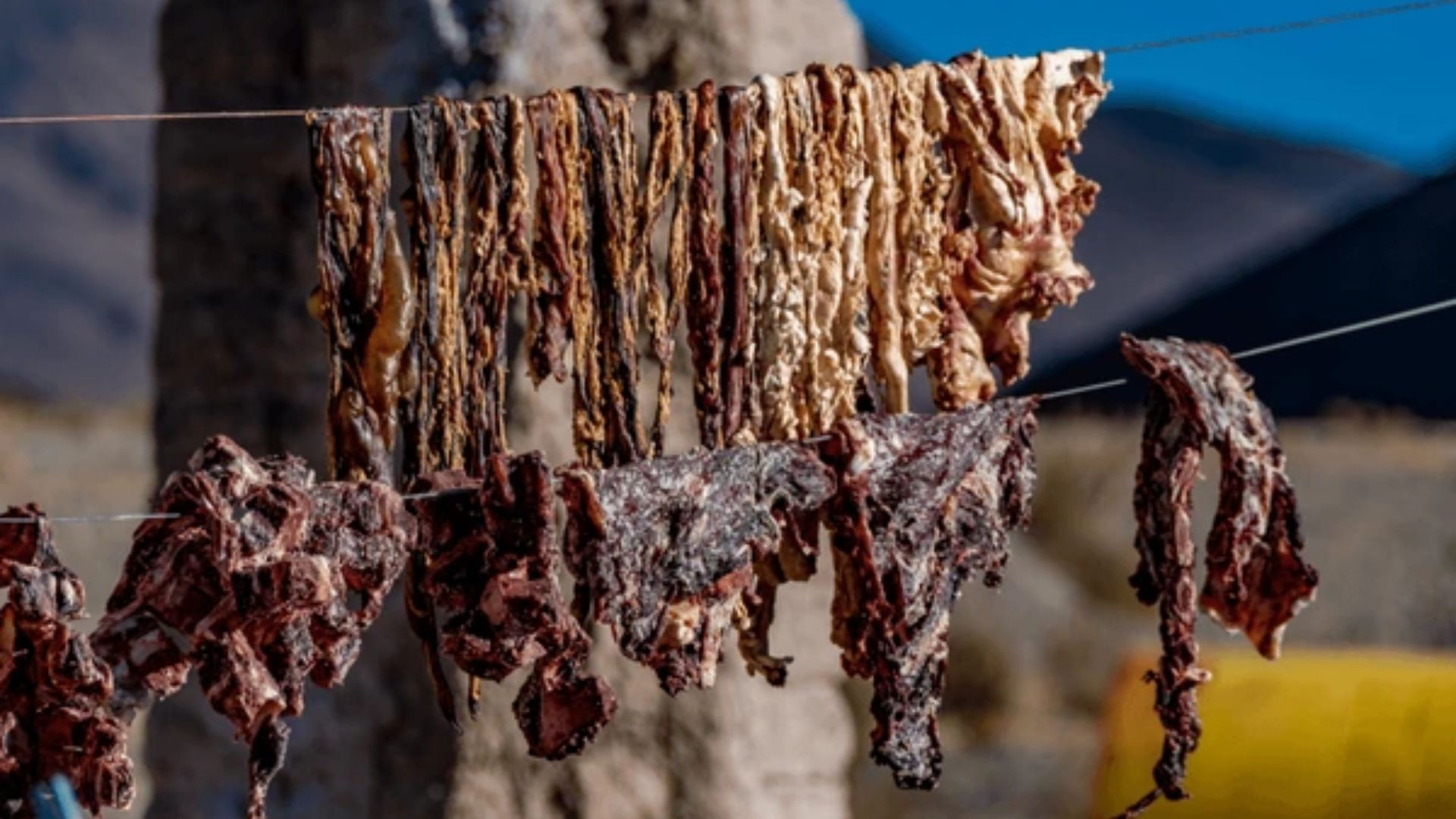
Dehydrated Meat in the Inca Time.
Dehydrated meat was a culinary and logistical masterpiece known as Ch’arki (from the Quechua word meaning “dry” or “dried meat”). It was used in various strenuous activities and in a wide variety of dishes. It is the direct ancestor of modern jerky.
This food was used in the Inca Empire, which stretched across a vast and rugged territory, with roads connecting important cities (Machu Picchu). Throughout the empire, preserving protein was essential to feed its enormous armies and the chasquis (royal messengers).
Contents
1. The Two Main Types – Dehydrated Meat.
- Ch’arki: Usually made from llama or alpaca meat. It was deboned, sliced into thin strips, and dried.
- Chalona: This refers specifically to meat dried on the bone (often whole carcasses of smaller animals like lamb or young alpaca). It is still common in Andean markets today.
2. The Ancient Preservation Process
The Incas utilized the unique climate of the Andes—intense daytime sun and freezing nighttime temperatures—to naturally freeze-dry their food.
- Slicing: The meat was sliced thin (about 5mm) to ensure even drying.
- Salting: It was heavily salted to draw out moisture and prevent bacterial growth.
- The “Freeze-Dry” Cycle: The meat was left outside during the coldest months (May to August). At night, it would freeze; during the day, the intense high-altitude sun would evaporate the ice without melting it (sublimation).
- Pounding: After a few days, people pounded the strips between stones to make them even thinner and more pliable, speeding up the final drying process.
3. Dehydrated Meat, Cultural and Strategic Importance
- Military Fuel: Ch’arki was the primary protein source for the Inca army. It was lightweight, making it easy for soldiers to carry in their packs while marching thousands of miles.
- State Reservoirs: The Incas stored massive quantities of ch’arki in Qollcas (stone storehouses). This acted as a “social safety net” during droughts or famines.
- A Royal Luxury: While commoners ate it during festivals, the nobility often considered high-quality ch’arki a luxury and paid it as a labor tax (Mita) to the Empire.
4. How was it eaten?
Unlike modern jerky, which people often eat as a snack, the Incas usually rehydrate it.
- Soups & Stews: It was boiled in water to create nutrient-rich broths.
- Charquicán: A traditional stew made with ch’arki, potatoes, pumpkin, and corn that is still a beloved dish in Peru, Chile, and Bolivia today.
USES OF DEHYDRATED MEAT IN INCA TIMES
Dehydrated meat, known as ch’arki (boneless strips) and chalona (dried meat with bone), was much more than a simple snack. It was a strategic resource that fueled the expansion of the largest empire in pre-Columbian America.Many generations have used this staple in military campaigns, even to this day. Andean people consume it in large quantities as part of their diet. Here are some of the main uses of dehydrated meat during the Inca Period:
1. Military Logistics and Conquest
The most vital use of ch’arki was as a high-protein, lightweight ration for the Inca army.
- Mobility: An army of 35,000 soldiers could march thousands of miles without slowing down due to livestock or heavy food supplies.
- Durability: Travelers stored ch’arki in Tambo (inns/waystations) along the Qhapaq Ñan (Inca Road). This meant soldiers didn’t have to forage from local villages, which helped maintain political peace in newly conquered territories.
2. State “Social Security” and Famine Relief
The Inca government operated a massive system of thousands of storehouses called Qollcas.
- Emergency Reserves:People stored ch’arki alongside chuño (freeze-dried potatoes) to protect the population against crop failures caused by El Niño, droughts, or frosts.
- Longevity: The salt and freeze-drying process allows people to store ch’arki in these stone warehouses for 2 to 4 years—some chronicles even claim up to 10 years—without spoiling.
3. Religious and Ritual Offerings
The common people considered Dehydrated Meat – Ch’arki a “luxury” food, usually reserving it for special occasions.
- Ceremonial Feasts: During major festivals in Cusco, the Sapa Inca (Emperor) would distribute ch’arki to the general populace as a show of state generosity.
- Offerings: Because camelids (llamas and alpacas) were sacred, people often included their preserved meat in burials or burned it as offerings to the Pachamama (Mother Earth) and the Apus (Mountain Spirits).
4. Economy and Taxation (Mita)
The Inca Empire did not use money. Instead, they used labor and goods as currency.
- Tribute: Communities in the high Puna regions paid their taxes (Mita) to the Emperor in the form of ch’arki.
- Redistribution: The state would then move this meat to lower-altitude regions (like the coast) where fresh llama meat was scarce, ensuring protein reached all corners of the empire.
5. Daily Nutrition (The Rehydration Method)
Unlike modern jerky, which is tough and eaten dry, the Incas primarily used ch’arki as an ingredient. Dehydrated Meat.
- Soups and Stews: Cooks almost always rehydrate it in water to make thick, nutrient-dense soups like Chairo or Charquicán.
- Olluquito con Ch’arki: One of the oldest recorded dishes in the Andes, combining the olluco tuber with rehydrated ch’arki. This dish is still a staple in Cusco today!
Dehydrated Meat, Quick Comparison: Ch’arki vs. Chalona
| Feature | Ch’arki | Chalona |
| Preparation | Deboned, sliced thin, and pounded. | Dried on the bone (whole carcass). |
| Animal | Usually Llama or Alpaca. | Originally Camelid; today mostly Lamb. |
| Primary Use | Rations for soldiers and travelers. | Base for heavy, flavorful soups/broths. |